
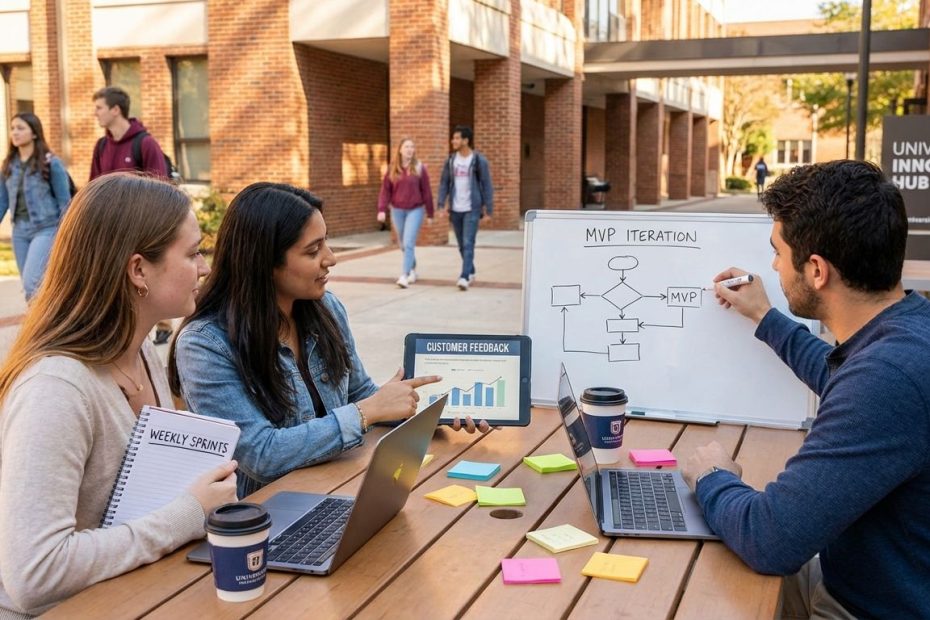
Successful student entrepreneurs win by running college like a growth engine, using the campus as a customer lab, a credibility builder, and a talent pipeline while keeping execution tight and measurable.
This article breaks down the repeatable lessons that show up across student-founded wins, from early validation habits taught in programs like Stanford’s Startup Garage to practical resource models like student incubators. You’ll get clear decision rules for school vs. full-time building, a time management operating system that survives exam weeks, and a skill plan that eliminates the “no real skills” anxiety without wasting semesters.
How Do Student Entrepreneurs Actually Start A Business While Still In College?
You start faster in college when you treat campus as a controlled market, not as a place to “prepare someday.” The advantage is proximity: customers live next door, your distribution is physical and digital, and feedback loops run in days rather than quarters. Stanford’s Startup Garage highlights this muscle by pushing students to form hypotheses, test them with real users, and accept disproof quickly so time doesn’t leak into pet ideas.
Execution looks less like writing a 30-page business plan and more like running a tight validation sprint. Pick one narrow segment you can reach without paid ads, then capture demand with a simple offer that forces a yes-or-no response. Pre-orders, waitlists, paid pilots, and service-first prototypes beat “coming soon” demos, because money, time commitments, and repeat usage expose truth. When you build from measurable demand, product scope stays small, your customer conversations stay frequent, and you learn what people pay for rather than what they compliment.
College also gives a structural edge: you can recruit collaborators and early hires more easily than most first-time founders can outside school. Use that advantage with discipline. Define one owner for growth, one for product delivery, one for operations, then run weekly deliverables with a visible scoreboard. A team of students can ship quickly when responsibilities are explicit and meetings exist to make decisions, not to socialize.
What Are The Biggest Lessons From Successful Student-Founded Companies Like Reddit Or DoorDash?
Lesson one is constraint-driven focus. Student founders rarely have abundant time, cash, or experience, so the winners keep the first version simple and push it into reality fast. Reddit’s origin is a clean reminder that a product can start small, look imperfect, and still become massive when it solves a core behavior and improves through use. Reddit was founded by University of Virginia roommates Steve Huffman and Alexis Ohanian in June 2005, with early growth coming from shipping, learning, and keeping the product active.
Lesson two is customer truth over founder intuition. DoorDash’s early story is an on-the-ground example of student founders doing high-volume customer conversations, then adjusting the product toward what buyers asked for. Stanford’s write-up notes the team spoke with many local business owners, found a delivery pain point, and built momentum from that fieldwork rather than from theory. That behavior, consistent interviews, tight experiments, fast pivots, shows up across student wins because it prevents months of building in the wrong direction.
Lesson three is structure beats motivation. Most student founders feel motivated at the start, then lose time to classes, distractions, and unforced complexity. The winners install cadence: a fixed weekly schedule for shipping, a pipeline for selling, and a habit of reviewing numbers. You can stay a student and still run a serious company when the business runs on routines that survive stress weeks.
Do You Really Need College If You’re Already Making Money As A Student Entrepreneur?
If revenue already exists, college is no longer a default step, it becomes an investment decision with explicit tradeoffs. The best decision rule is to measure what college uniquely provides that the business cannot: credential signaling for certain buyers, structured skill-building, access to mentors, and a peer network that compounds for years. In one active Reddit discussion, the strongest pro-college arguments center on credibility with enterprise-style clients, structured thinking, and network depth rather than on classroom theory.
The strongest anti-college arguments are opportunity cost and dilution of focus. If a business is already producing profit and customer pull, the question becomes whether school increases the speed of growth or simply adds obligations. A balanced strategy often wins: keep building, reduce academic load, choose a program structure that protects execution, and extract the parts of school that directly increase deal flow and decision quality. This is not about “backup plans,” it’s about preserving options without starving the core engine that already works.
To decide cleanly, use a quarterly review with three numbers: customer growth rate, profit margin, and personal time cost. If the business grows and your time stays manageable, staying enrolled part-time or choosing a lighter academic path can keep optionality without killing momentum. If the business needs full-time attention to capture a time-sensitive market, then school must prove it improves outcomes enough to justify the drag.
How Do Student Founders Balance Classes, Exams, And Running A Startup?
Balance is an operational problem, not a willpower problem. You protect the business by scheduling it like a job with non-negotiable blocks, then designing the academic plan around those blocks. Guidance for college-aged entrepreneurs emphasizes planning, cutting low-value commitments, and being honest about workload so burnout doesn’t wipe out both grades and progress.
Start with a weekly “execution minimum” that stays intact even during exams. Lock a fixed number of hours for sales and delivery, because these activities keep the business alive and generate learning. Then build a rule for meetings: no meeting without a decision, no meeting without an owner, no meeting without a next action. When the calendar tightens, vague coordination becomes the silent killer.
Student founders also need a filtering system for campus activities. Some business clubs create motion without output, especially when events replace building and accountability disappears. That skepticism shows up in student conversations, and it’s useful because it forces a hard standard: participate only where the outcome is measurable, customers, revenue, prototypes, hires, or distribution.
Where Do Student Entrepreneurs Find Funding, Mentorship, And Resources On Campus?
Campus resources work best when they bundle structure, feedback, and access into a single channel. University incubators and accelerators do this well because they compress learning into milestones, connect you with mentors, and provide space and peer accountability. The University of Arkansas announced a 10-week student business incubator model built around workshops, mentorship, and co-working support, which is exactly the kind of program that can prevent student founders from drifting.
Courses can also act as a resource pipeline when they are designed for real execution rather than theory. Stanford’s Startup Garage is explicitly built around hypothesis-testing, fieldwork, and real-world application, which is why it has produced multiple ventures that began as class projects. When course deliverables match startup deliverables, customer interviews, pilots, product tests, you gain momentum instead of losing time.
Scale matters too, because scale indicates choice and network density. The University of Maryland points to large enrollment in entrepreneurship courses, which signals a broad ecosystem where collaborators, mentors, and events are easier to find. You are not looking for a logo on a brochure, you are looking for repeated collisions with people building real things, plus staff who can open doors to alumni and local operators.
What Skills Do Student Entrepreneurs Need Most If They Feel They Have “No Real Skills Yet”?
The fastest way out of the “no skills” trap is to pick one skill that produces revenue and practice it daily. Early-stage companies run on distribution and delivery, so sales and customer development usually create the highest return. You also need a “make” skill that lets you ship without waiting: building a simple product, delivering a service, writing copy that converts, running paid acquisition tests, or creating repeatable outreach. When these skills improve, confidence stops being a mood and becomes an outcome.
The “no real skills” anxiety shows up often in entrepreneur communities, including students close to graduation who realize they cannot point to concrete, marketable output. That signal is useful because it forces a practical plan. Choose internships, campus roles, or part-time jobs that put you close to customers and revenue, early-stage startups, sales roles, growth roles, operations roles tied to metrics, not roles where success is measured by attendance or slide decks.
Pair the skill plan with proof artifacts that recruiters, customers, and partners can verify. Maintain a small portfolio: a landing page you built, a pipeline dashboard you run, a set of customer interview notes, a before-and-after conversion lift, a churn reduction, a revenue curve. When your work leaves evidence, opportunities increase, and your startup gains leverage even if it remains small at first.
What Do Students Actually Want From Entrepreneurship Education And What’s Missing?
Students want practical preparation, mission-driven work, and training that connects to real outcomes. The Student Entrepreneurship Monitor 2025 summary reports that many students interested in entrepreneurship want to learn new things and want their work to be socially relevant, while also reporting gaps in early preparation. It also notes a strong desire for earlier exposure to entrepreneurship education, with many students saying they would have wanted it taught in school, yet relatively few had access to it.
This gap matters because it shapes how you should use college. If formal education does not provide the reps, you create them through projects, paid pilots, and structured programs that force output. The winning pattern is to treat campus resources like a menu: choose what speeds execution, skip what creates performative activity. That includes being selective with clubs, competitions, and speaker events unless they connect directly to customers, funding, hires, or distribution.
Students also demand proof, not slogans. A current thread asking about startups that actually came out of college reflects that credibility comes from concrete stories and visible builders. Use that standard on your own campus: ask which programs produce companies that ship, sell, and survive beyond demo day. If the answers are vague, build your own mini-accelerator with peers, weekly shipping deadlines, and customer-facing targets.
How Can A Student Start A Business In College?
- Pick one campus problem
- Interview 20 users
- Sell a small pilot
- Ship weekly, track revenue, retention
Build Your Student Founder Plan And Ship This Week
Successful student entrepreneurs stack small, measurable wins: validate demand early, protect time with a strict calendar, and build skills that create revenue and proof. Use campus programs and incubators for structure, mentors, and accountability, then keep your business anchored in customer conversations and weekly shipping. Decide on college with numbers and options in mind, not with vague fear about “backup plans.” When skill gaps show up, close them with one revenue-linked skill and visible output artifacts. Keep your standard high, build where results are measurable, and treat every semester as a chance to increase deal flow, decision quality, and execution speed.
If building alongside school is the current priority, more practical operator-grade posts are available here: visit my website and keep the momentum going.
References
- Reddit thread: “19, already running a small business making money. do i even need college?” (r/Entrepreneur) ([reddit.com](https://www.reddit.com/r/Entrepreneur/comments/1r61v2d/19_already_running_a_small_business_making_money/))
- Stanford GSB: “Startup Garage Celebrates Five Years” ([gsb.stanford.edu](https://www.gsb.stanford.edu/experience/news-history/startup-garage-celebrates-five-years))
- University of Arkansas: “U of A’s Incubator to Boost Student Startups” ([news.uark.edu](https://news.uark.edu/articles/72713/u-of-a-s-incubator-to-boost-student-startups))
- Stanford (The College Puzzle): “8 Considerations for College-Aged Entrepreneurs” ([collegepuzzle.stanford.edu](https://collegepuzzle.stanford.edu/8-considerations-for-college-aged-entrepreneurs/))
- Maryland Today: UMD entrepreneurship and innovation brief ([today.umd.edu](https://today.umd.edu/briefs/umd-named-among-top-global-innovation-and-entrepreneurship-schools-by-fast-company-inc))
- Startbase: “Student Entrepreneurship Monitor 2025” summary ([startbase.com](https://www.startbase.com/news/student-entrepreneurship-monitor-2025/))
- Wikipedia: Reddit overview ([en.wikipedia.org](https://en.wikipedia.org/wiki/Reddit))
- Wikipedia: DoorDash overview ([en.wikipedia.org](https://en.wikipedia.org/wiki/DoorDash))
- Reddit thread: “College business clubs are useless (prove me wrong)” (r/college) ([reddit.com](https://www.reddit.com/r/college/comments/ywkgvn))
- Reddit thread: “Im in my last year of college and have no real skills.” (r/Entrepreneur) ([reddit.com](https://www.reddit.com/r/Entrepreneur/comments/1fz3qe3))
- Reddit thread: “what are some cool startups that actually came out of your college?” (r/Entrepreneur) ([reddit.com](https://www.reddit.com/r/Entrepreneur/comments/1r6ziqu/what_are_some_cool_startups_that_actually_came/))

Brian C Jensen is the CEO of Legacy Global Consulting, Inc., a management consulting firm. With 10+ years of experience, he advises organizations on digital transformation, risk management, and growth strategy—helping clients anticipate market shifts and scale sustainably.