
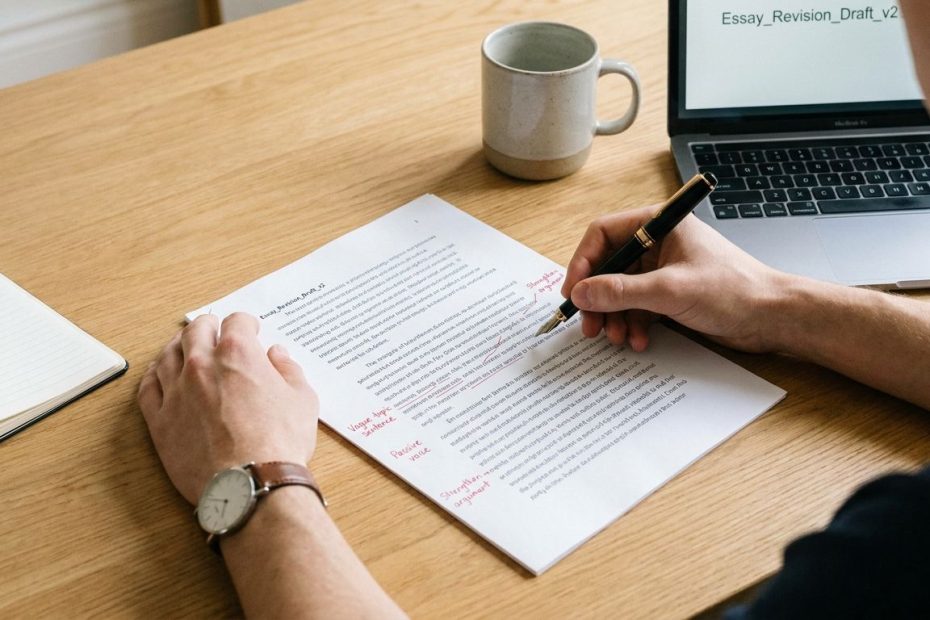
Students usually weaken essays in the same predictable ways: they miss the prompt, build around a vague thesis, use evidence without enough analysis, organize paragraphs poorly, and leave avoidable grammar or citation errors in the final draft. When you fix those pressure points, your writing becomes sharper, easier to follow, and much more likely to earn stronger grades.
This article breaks down the mistakes that cost students marks most often and shows you how to correct them before submission. You will see where essays usually go wrong, how instructors read weak drafts, and what practical editing moves improve clarity, argument, structure, and source use. By the end, you will know how to review your own paper with a stricter, more effective standard.
Why Do Students Lose Marks Even When Their Essay Sounds Good?
A polished sentence is not the same thing as a strong essay. You can write in a fluent, formal style and still lose marks if your paper does not answer the assignment, present a clear argument, or support claims with relevant evidence. Many students mistake surface polish for academic strength, but instructors usually grade for substance first. If the paper sounds smart yet says very little, the weakness shows up fast.
This happens when writing aims for an “academic” tone before securing a clear purpose. Long sentences, elevated vocabulary, and general statements can create the appearance of sophistication, but they do not replace argument. An instructor wants to see that you understood the prompt, made a defensible claim, and developed that claim with reasoning. When those elements are weak, style cannot rescue the grade.
You can detect this problem by asking a blunt question: if the phrasing were simpler, would the essay still have a strong point? If the answer is no, the paper depends too much on tone and not enough on substance. Strong essays earn marks because they are focused, relevant, and well supported. Good writing style matters, but it works best when it serves a clear argument instead of masking its absence.
Another common issue is that students submit drafts that read like they are circling the topic rather than engaging it directly. The essay may sound informed, but the introduction does not commit to a real claim, the body paragraphs repeat the same broad idea, and the conclusion restates language without proving anything new. That kind of draft feels finished to the writer because it flows smoothly, yet it feels underdeveloped to the reader because it never locks onto a precise point.
You avoid this by judging your essay the way a marker does. Look for task completion, not just readability. Ask whether the paper answers the exact question, whether the thesis can be debated, whether each paragraph has a job, and whether the evidence leads to analysis instead of summary. Once you review your work at that level, the difference between sounding good and performing well becomes much easier to spot.
What Is The Biggest Mistake Students Make In An Essay?
The biggest mistake is writing without a clear, arguable thesis. When your central claim is vague, descriptive, or too broad, the rest of the paper loses direction. Paragraphs start drifting, evidence gets dropped in without purpose, and your conclusion ends up sounding recycled. A weak thesis does not just weaken the introduction; it weakens the entire draft.
Many students think a thesis is simply the topic of the essay stated in sentence form. It is not. A real thesis makes a specific claim that your paper will defend. If your opening line says that a subject is important, complex, or worth discussing, you have not given the reader an argument. You have only announced the general subject area.
The damage shows up quickly in the body paragraphs. Without a strong thesis, each paragraph becomes an isolated point instead of part of a coordinated argument. One paragraph may summarize a reading, another may provide a loose opinion, and another may introduce evidence that never gets fully explained. The essay may stay on the broad topic, yet it still feels scattered because there is no controlling idea holding it together.
You fix this by tightening the claim before drafting the body. A good thesis tells the reader what position the essay takes, what line of reasoning it will follow, and what the paper is actually trying to prove. It should be narrow enough to manage within the word count and strong enough that someone could reasonably question it. If no one could disagree with the statement, it is probably too obvious to drive a serious essay.
One effective editing move is to underline the sentence you believe is your thesis, then test every body paragraph against it. If a paragraph does not directly support, explain, or qualify that claim, it probably does not belong in the draft. This single review habit improves focus fast. Once the thesis becomes sharper, structure, evidence, and analysis usually improve with it.
How Can You Tell If Your Essay Is Off-Topic?
Your essay is off-topic when it responds to the general subject but not the actual task in the prompt. This is one of the most expensive mistakes in academic writing because you can lose marks across argument, relevance, structure, and evidence all at once. Students often think they are safe because the paper covers the assigned text or issue. The real question is whether the essay performs the exact job the prompt asks for.
The trouble often begins with instruction words. If the prompt says analyze, compare, evaluate, explain, or argue, each of those verbs requires a different kind of response. A paper can be full of accurate information and still fail because it summarizes when it should analyze, or describes when it should evaluate. This is why essays sometimes get feedback like “well written but does not answer the question.” The writing may be competent, but the task was misunderstood.
You can catch this early by translating the prompt into plain language before you draft. Strip away the longer wording and identify what the instructor is asking you to do, what material you must use, and what limits the assignment sets. If the prompt asks you to compare two authors’ methods, a long paragraph on background history may feel useful but still distract from the assignment. Relevance is determined by the task, not by whether the information is interesting.
A reliable test is to place a short label next to each paragraph explaining its function. If you cannot explain in a few words how that paragraph helps answer the prompt, it is probably drifting. This matters even more in longer essays, where students often include extra material to sound thorough. Extra material is not a strength when it pulls the paper away from its purpose.
You avoid off-topic writing by keeping the assignment visible during planning and revision. Build your thesis from the prompt language, then make sure every paragraph moves that response forward. When the essay stays aligned with the action verb, scope, and required material, your paper feels tighter and earns marks for relevance as well as clarity.
How Much Evidence Should An Essay Include?
An essay needs enough evidence to support every major claim, but not so much that your own analysis disappears. This balance is where many students struggle. Some drafts rely on broad claims with barely any support, which makes the argument sound unsupported. Other drafts overload the page with quotations, examples, and source material, which makes the paper feel borrowed rather than argued.
The right amount depends on the claim you are making and the type of assignment you are writing. A sharper, more specific claim often requires fewer pieces of evidence because each one can be analyzed in depth. A broad claim usually demands more support, yet broad claims are often weaker anyway because they force the writer to cover too much ground. Strong essays usually select evidence with care and then spend time explaining why it matters.
Evidence should not sit in the paragraph like a dropped object. Once you present a quotation, paraphrase, statistic, or example, you need to connect it to the point of the paragraph and then back to the thesis. Many students stop after inserting the source, assuming the meaning is obvious. Instructors do not want to guess why a piece of evidence appears. They want to see your reasoning spelled out in direct, efficient prose.
This is where a useful rule can help: make sure your analysis takes up at least as much space as the evidence itself, and often more. If your paragraph includes a long quotation followed by one sentence of comment, the source is doing the intellectual work for you. Your job is to interpret, connect, and evaluate. The source supports your argument; it does not replace it.
You can improve evidence use by checking each body paragraph for three parts: a clear claim, relevant support, and explanation. When one of those parts is missing, the paragraph weakens. If the claim is strong but unsupported, it sounds unproven. If the support is present but unexplained, it feels incomplete. When all three work together, the essay sounds controlled and persuasive.
Why Does Your Essay Feel Choppy Or Hard To Follow?
An essay feels choppy when the ideas do not build in a logical sequence. This usually comes from paragraph-level problems, not just sentence-level ones. If a paragraph jumps between multiple points, if transitions are thin, or if the paper keeps changing direction without warning, the reader has to do too much connecting work. That effort shows up in feedback like “unclear,” “awkward flow,” or “needs better organization.”
One major cause is weak paragraph control. A strong paragraph usually develops one main idea and stays with it long enough to make that idea meaningful. Students often compress two or three different points into one paragraph, then move on before any of them are fully developed. The result is writing that feels rushed, fragmented, and harder to absorb even when the grammar is fine.
Another cause is poor sequencing. Your points may all be relevant, yet they may appear in the wrong order. If you introduce evidence before stating the claim it supports, or if you raise a counterpoint before establishing your main position, the paper can feel disjointed. Strong essays guide the reader from one idea to the next with deliberate progression. That progression matters more than decorative transition words.
To fix choppiness, review the first sentence of every paragraph in order. Those sentences should form a visible chain of reasoning. If they read like unrelated notes, your structure needs work. You can also check whether each paragraph ends by reinforcing the point or linking forward to the next idea. Paragraph endings are often neglected, yet they play a major role in making the essay feel controlled.
You also need to watch for sentence variety without sacrificing clarity. If every sentence has the same length and rhythm, the writing can become flat. If every sentence is long and packed with multiple clauses, the writing can become muddy. A controlled mix of short and longer sentences improves readability, but structure still does the heavier lifting. When your paragraphs are focused and logically ordered, flow improves across the whole essay.
What Are The Most Common Grammar And Proofreading Mistakes In Student Essays?
The most common grammar and proofreading problems are not exotic errors. They are the recurring issues that weaken clarity: sentence fragments, run-on sentences, comma splices, unclear pronoun references, repeated wording, punctuation slips, and misspellings that survive spell-check because the wrong word is still a real word. These mistakes distract the reader and reduce confidence in the paper, even when the underlying ideas are decent.
Students often underestimate how much small errors affect the reading experience. A single typo may not matter much, but repeated sentence errors make the essay feel less controlled. When a marker has to reread a sentence to understand where it begins or ends, the flow breaks. Once that happens several times, even a promising argument can feel less convincing.
Proofreading also fails when students do it too late or too quickly. Reading the paper once on a screen and fixing obvious spelling mistakes is not enough. Your eyes tend to see what you meant to write, not what is actually on the page. That is why repeated words, missing words, and punctuation mistakes often survive until submission. A rushed final read catches less than most students assume.
You get better results by separating editing from proofreading. Editing deals with argument, organization, paragraph structure, and clarity of meaning. Proofreading targets grammar, spelling, punctuation, and formatting. When you combine them in one rushed pass, neither gets enough attention. Handle the big issues first, then perform a slower final review for sentence-level errors.
Reading the essay aloud helps identify awkward syntax and missing words. Printing the draft or changing the font can also make familiar sentences look new enough to notice errors. Another useful move is to review one problem at a time. Read once for sentence boundaries, once for punctuation, once for citation format, and once for repeated words. This method is more efficient than scanning for everything at once.
How Do Students Accidentally Plagiarize In Essays?
Students often plagiarize by accident when they misunderstand what counts as original phrasing and proper source use. The biggest risks are weak paraphrasing, patchwriting, copying sentence structure too closely, forgetting quotation marks, or citing a source after borrowing language that remains too close to the original. Many students assume that adding a citation solves every issue. It does not.
Patchwriting is a major problem because it feels safe to inexperienced writers. You may keep the original sentence structure, swap a few words, and add a citation, believing the material is now acceptable. It is not. If the wording and shape of the sentence still belong mostly to the source, the paraphrase remains too close. This can trigger plagiarism concerns even when there was no intent to deceive.
Accidental plagiarism also happens during note-taking. Students copy useful phrases into their notes without quotation marks, then later forget which wording came from the source and which wording was their own. By the time the draft is assembled, borrowed language slips in unnoticed. This is less a formatting problem than a workflow problem. Weak research habits create citation trouble long before the final draft.
You avoid this by using a stricter process when working with sources. Read the source carefully, set it aside, and write the idea in your own words from memory. Then return to the original to check accuracy and add the citation. If a phrase from the source is especially precise and needs to remain unchanged, put it in quotation marks immediately. Do not wait until the final draft to decide what must be quoted.
You should also review paraphrases with the original source open beside you. Compare wording, sentence pattern, and order of ideas. If your version tracks too closely, rewrite it again. Proper source use protects your credibility and strengthens your writing because it forces you to process the material rather than copy its structure. That produces cleaner prose and better analysis at the same time.
What Are The Most Common Essay Mistakes?
- Missing the prompt or misunderstanding the task
- Using a vague or descriptive thesis
- Adding evidence without enough analysis
- Writing unfocused paragraphs with weak flow
- Leaving grammar, proofreading, or citation errors in the final draft
Write With Control, Not Last-Minute Panic
The essays that earn stronger grades are usually not the ones with the fanciest vocabulary. They are the ones that answer the prompt directly, commit to a clear thesis, organize paragraphs with purpose, and explain evidence instead of stacking it. When you review your writing with those standards, weak spots become easier to diagnose and fix. Treat revision as performance work, not cleanup. If you tighten the claim, sharpen paragraph control, and handle sources carefully, your essays will read with more authority and deliver stronger results.
References
- Towson University, Common Problems with Student Papers: https://www.towson.edu/cla/departments/history/resources/succeedinginhistory/papers.html
- Harvard College Writing Center, Thesis: https://writingcenter.fas.harvard.edu/thesis
- Harvard College Writing Center, Tips for Reading an Assignment Prompt: https://writingcenter.fas.harvard.edu/tips-reading-assignment-prompt
- Purdue Online Writing Lab, Using Logic: https://owl.purdue.edu/owl/general_writing/academic_writing/logic_in_argumentative_writing/using_logic.html
- Purdue Online Writing Lab, On Paragraphs: https://owl.purdue.edu/owl/general_writing/academic_writing/paragraphs_and_paragraphing/index.html
- University of Louisville Writing Center, Writing with Sources and Avoiding Plagiarism: https://louisville.edu/writingcenter/writing-resources/resources-teaching-writing/writing-sources-and-avoiding-plagiarism
- University of Wisconsin–Madison Writing Center, Twelve Common Errors: https://writing.wisc.edu/handbook/commonerrors
- University of North Texas Writing Center, Helping Students to Avoid Plagiarism: https://writingcenter.unt.edu/helping-students-avoid-plagiarism.html
- University of North Texas Libraries, Mosaic Plagiarism or Patchwriting: https://guides.library.unt.edu/plagiarism/patchwriting

Brian C Jensen is the CEO of Legacy Global Consulting, Inc., a management consulting firm. With 10+ years of experience, he advises organizations on digital transformation, risk management, and growth strategy—helping clients anticipate market shifts and scale sustainably.